

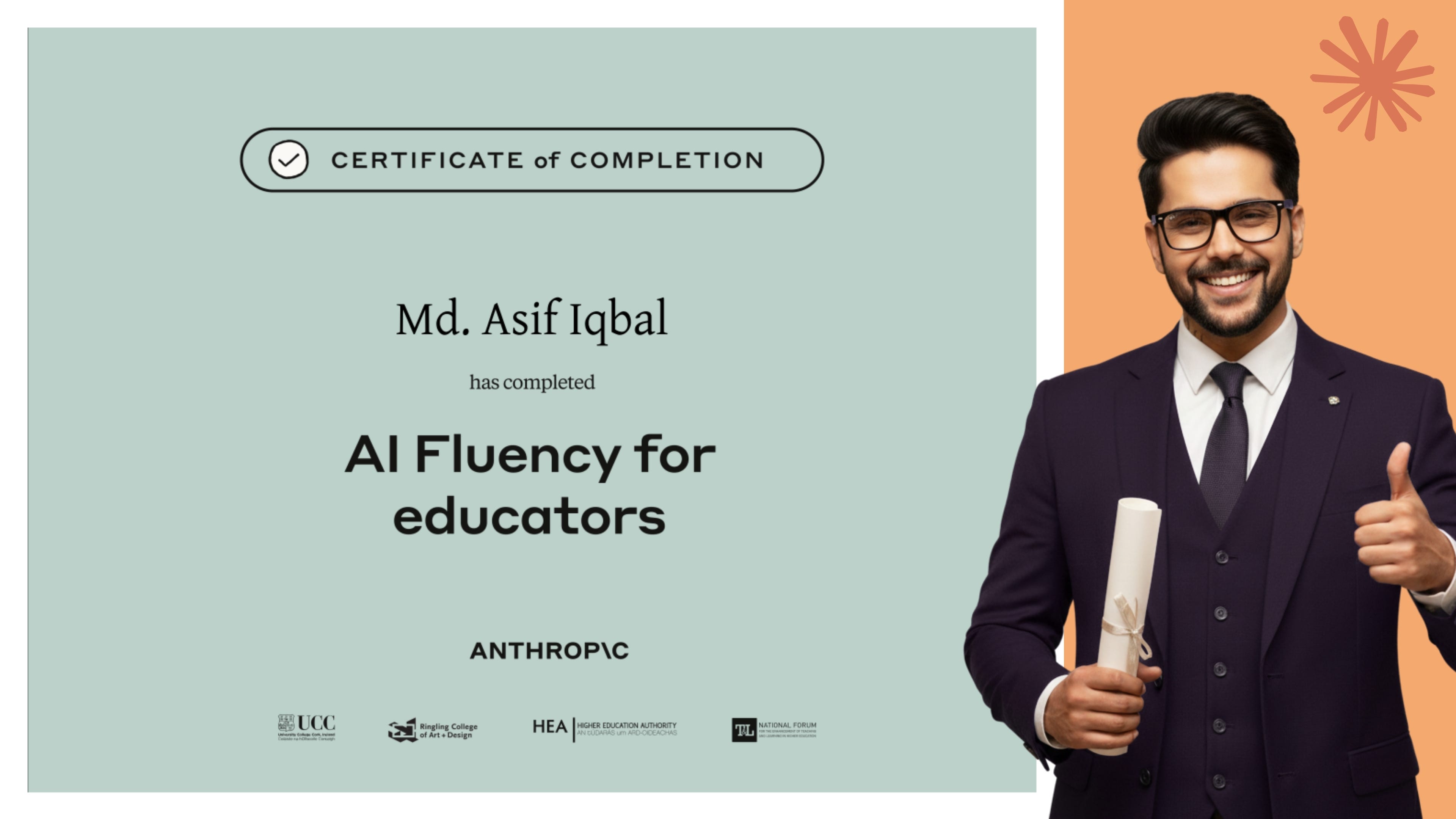
That certificate above is mine. I earned it this week, issued by Anthropic, sitting on my LinkedIn profile right now.
I teach at university. I build content around AI, entrepreneurship and the creator economy under TechnoPreneurship. I spend a significant amount of my week inside AI tools. And I will be honest: I had no idea how many official learning resources Anthropic had quietly published until I went looking.
There are 18 courses. Free. All of them. Hosted on Anthropic’s own Academy at anthropic.skilljar.com. Some take an hour. Some take three. Together they cover everything from basic Claude usage to building with the API, setting up Model Context Protocol servers, agentic workflows, and AI fluency frameworks for educators, students, nonprofits, and small businesses.
Before anything else: if you have seen paid “Claude certifications” online, they are not from Anthropic. Anthropic does not endorse a single one of them. The real ones are listed below and they are completely free.
Here is the full map of every course, who it is for, what it actually covers, and why it is worth your time.
Why this matters right now
I am going to give you two numbers and then we can move on.
Right now, actually having used these tools puts you ahead of more than 98% of the workforce. A certificate from Anthropic does one small but important thing: it makes that fact visible on your profile.
“A certificate means nothing if you haven’t played with the tool. But if you have, the certificate makes it visible.”
With that said, here is every course Anthropic currently offers, grouped by who they are built for.
Track 1: For everyday users and content creators
If you use Claude for work, content, research, or personal productivity, start here. These four courses are your foundation.
1. Claude 101
1 hour · 13 lessons, 5 modules
Covers what Claude actually is, when to use Chat vs Cowork vs Code, how Projects work, how Skills work, and how to connect Gmail, Drive and Slack. This is where I started. More complete than the title suggests. Do this first regardless of your experience level.
2. AI Fluency: Framework and Foundations
3 hours · The most valuable course on this list
The 4Ds: Delegation, Description, Discernment, Diligence. This is the course that changes how you think about AI, not just Claude. It covers effective prompting, critical evaluation of outputs, and the ethics of AI collaboration. If you only do one course, make it this one. The vocabulary cheat sheet alone is worth bookmarking.
3. Introduction to Claude Cowork
2 hours · Most underrated feature in Claude
Cowork is the agentic, multi-step side of Claude that most users never touch. This course covers the Cowork task loop, Plugins, Skills, file and research workflows, permissions, and how to pick the right model for different jobs. If you are using Claude for anything beyond simple chat, this is essential.
4. AI Capabilities and Limitations
Introductory · Good for new starters
A foundational explainer on how AI actually works. Not just Claude, AI in general. Useful if you need to explain AI tools to a team, a class, a client, or someone who keeps asking you “but how does it know that?” A good pairing with AI Fluency.
Track 2: For developers and builders
If you build with Claude, call it via API, or want to understand the technical architecture, these six courses are your track. Some require coding knowledge.
5. Claude Code 101
Developer-focused foundation
How to use Claude Code effectively in your daily development workflow. The starting point for any developer new to Claude Code. Sets the context for everything in the developer track.
6. Claude Code in Action
Practical · Hands-on workflow integration
Takes the foundation from Claude Code 101 and goes practical. How to integrate Claude Code into a real development workflow, not just theory. Follow-on to course 05.
07. Building with the Claude API
Comprehensive · Full API spectrum
The definitive course for anyone building products with Claude. Covers the full range of working with Anthropic models through the API: requests, responses, tool use, prompt engineering, and more. If you are integrating Claude into anything you are building, this is the one.
08. Introduction to Model Context Protocol
MCP foundations · Python-based
MCP is the open standard that lets AI models connect to external services, databases, and tools. This course teaches you how to build MCP servers and clients from scratch using Python, covering the three core primitives: tools, resources, and prompts. This is where the real extensibility of Claude lives.
anthropic.skilljar.com/introduction-to-model-context-protocol ↗
09. Model Context Protocol: Advanced Topics
Advanced · Production-level MCP
Sampling, notifications, file system access, and transport mechanisms for production MCP server development. A direct follow-on to course 08. If you are building real tools with MCP, you need both of these.
anthropic.skilljar.com/model-context-protocol-advanced-topics ↗
10. Introduction to Agent Skills
Claude Code · Reusable skill architecture
How to build, configure, and share Skills in Claude Code. Skills are reusable markdown instructions that Claude automatically applies to the right tasks. Goes from creating your first Skill through to distributing them across teams and troubleshooting. Genuinely useful if you are building any kind of workflow automation.
11. Introduction to Subagents
Claude Code · Multi-agent architecture
How to use and create sub-agents in Claude Code to manage context, delegate tasks, and build specialised workflows. This is for anyone building systems where one agent coordinates others. Keeps your main conversation clean and focused while complex work runs in parallel.
Track 3: For educators and institutions
As a university lecturer, this track sits closest to my professional world. Anthropic has put genuine thought into how AI fluency applies across academia, which is more than most AI companies have done.
12. AI Fluency for Educators
Faculty and instructional designers
How to apply AI Fluency principles into your own teaching practice and institutional strategy. Built for faculty, instructional designers, and educational leaders. As someone who teaches project management at university, I found the framing here genuinely useful for thinking about how to bring AI literacy into a curriculum.
13. AI Fluency for Students
Learning, career planning, academic success
Develops AI Fluency skills for students specifically around learning, career planning, and responsible AI collaboration. If you work with students or have students in your life who are trying to figure out how to use AI without it using them, point them here before anywhere else.
14. Teaching AI Fluency
Instructor-led settings · Facilitation guide
How to teach and assess AI Fluency in an instructor-led setting. The practical complement to the Educators course. This one is about delivery, facilitation, and assessment, not just understanding the content yourself. Relevant for anyone who needs to run AI training sessions inside an organisation or classroom.
Track 4: For organisations and cloud teams
These courses cover AI fluency for specific organisational contexts, plus the two cloud platform integrations for teams already on AWS or Google Cloud.
15. AI Fluency for Nonprofits
Mission-aligned AI adoption
Helps nonprofit professionals develop AI fluency in a way that stays true to their mission and values. Covers organisational impact and efficiency. Relevant for anyone in the third sector trying to make a case for AI adoption without losing sight of what actually matters.
16. AI Fluency for Small Businesses
SME-focused · Practical and operational
Same AI Fluency foundations adapted specifically for small business owners and their teams. Focused on increasing operational impact and efficiency. If you are an entrepreneur running a small team, this frames AI adoption in terms that are directly relevant to your day-to-day decisions.
17. Claude with Amazon Bedrock
AWS integration · Enterprise teams
Originally created as part of an accreditation programme for AWS employees. Anthropic made it publicly available. If your team is on AWS and you want to understand how Claude integrates through Amazon Bedrock, this is the official resource. Comes with full course content you can follow along with.
18. Claude with Google Cloud’s Vertex AI
GCP integration · Full spectrum
The Google Cloud equivalent. Covers the full spectrum of working with Anthropic models through Google Cloud’s Vertex AI platform. If your infrastructure is on GCP, this is where you start before touching anything else.

How to actually get certified and put it on LinkedIn
Every course on Anthropic Academy runs through Skilljar. You sign up with your email at anthropic.skilljar.com. No Claude subscription needed. No credit card. Nothing.
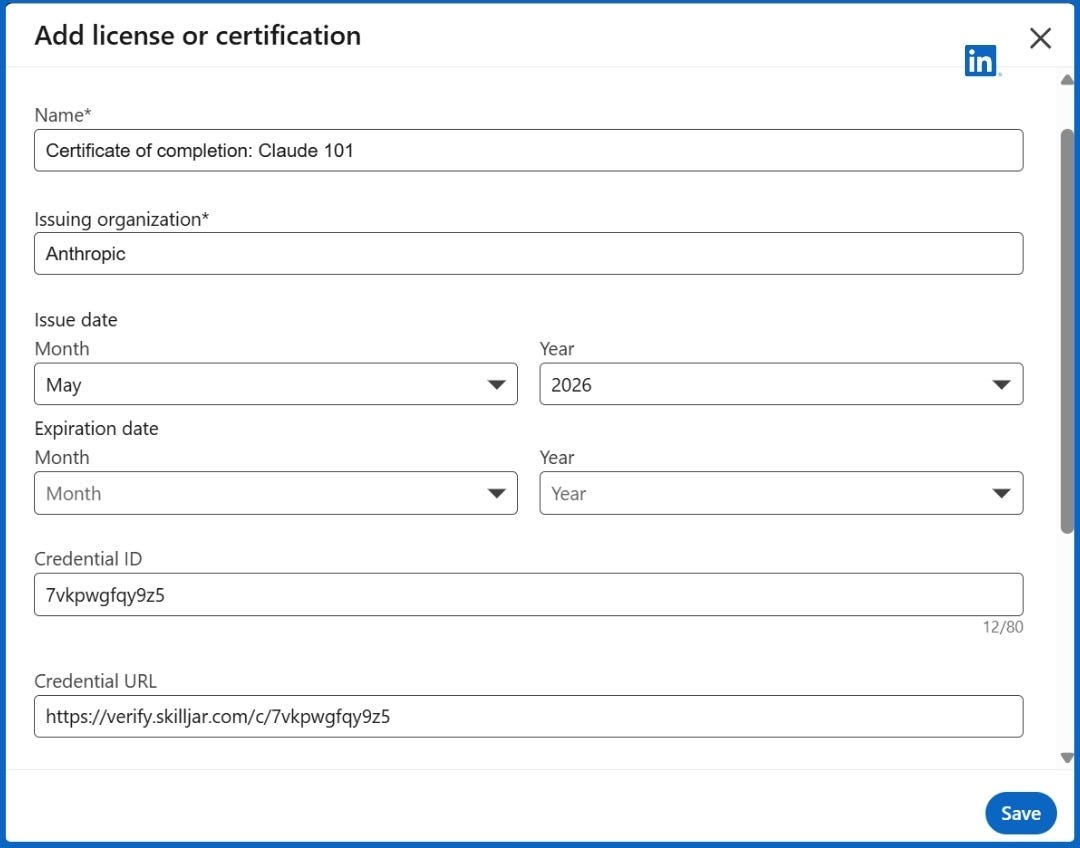
When you finish a course, Skilljar generates a certificate and gives you an “Add to LinkedIn” button that pre-fills the form. If you prefer to do it manually, here is the exact format:
LinkedIn format
Go to your profile and click Add section
Select Licenses and certifications
Name:
Claude 101 — Anthropic AcademyIssuing organisation:
AnthropicIssue date: the date you completed it
Credential URL: the link from your certificate page
Repeat for every course you complete
My recommended order if you are starting from scratch
Claude 101 first, one hour, and you have your first certificate. Then AI Fluency: Framework and Foundations, which is the three-hour course that actually changes how you think. Then Introduction to Claude Cowork if you use Claude for work. Then branch depending on whether you are a developer, educator, or working in an organisation.
If you are tight on time and can only do one: AI Fluency: Framework and Foundations. Every single hour of that course is worth it.
Start here
Go to anthropic.skilljar.com right now. Sign up with your email. Start with Claude 101. One hour later you have a certificate from the company that built one of the most widely used AI models in the world. It costs nothing.
Enjoyed this? Share it with one person who needs to read it.
If someone forwarded this to you and you want more, you can subscribe here.
Find me everywhere:
🔗 Facebook 🔗 Instagram 🔗 LinkedIn
This week’s ask: If this post saved you time, made you think, or gave you one useful idea — forward it to one person who needs it. That’s how good ideas spread.
Want more like this? I publish practical AI guides, prompt breakdowns, and creator strategies. If you’re not subscribed yet, hit the button below. It’s free.
Reply to this email anytime. I read every single one.